While popular fringe theories have long attributed speculative power-generation capabilities to the Great Pyramid of Giza, physical acoustic testing in the King's and Queen's Chambers reveals measurable standing wave behaviors, high-Q resonance, and distinct infrasound damping resulting from the precise structural geometry and megalithic rose granite masonry.
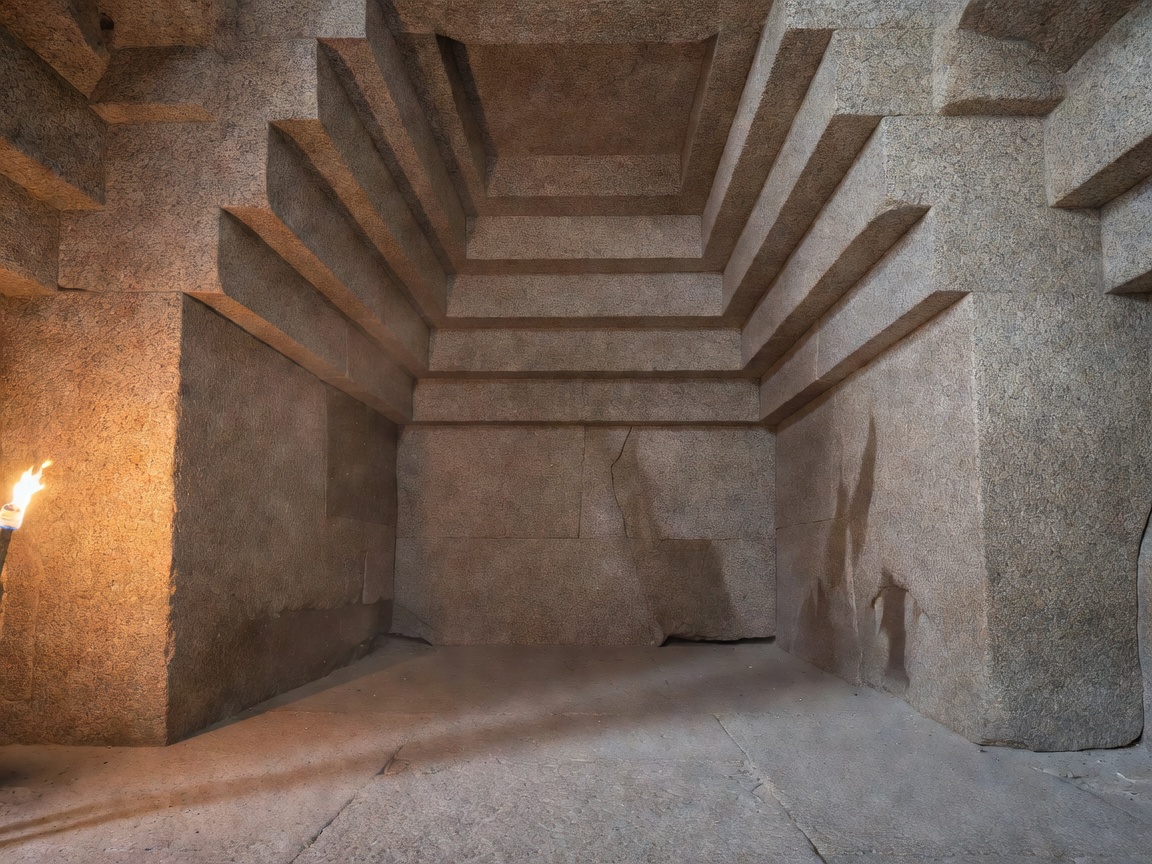
1. Physical Dimensions and Standing Wave Formation
The King’s Chamber is an unadorned rectangular room constructed entirely of polished Aswan rose granite blocks, measuring approximately 10.47 meters (east-west) by 5.23 meters (north-south), with a ceiling height of 5.81 meters. These dimensions conform strictly to a 1:2 base ratio and a 2:√5 height-to-diagonal ratio.
In architectural physics, any enclosed rectangular cavity bounded by rigid, non-porous surfaces acts as an acoustic resonator. When sound waves travel within the King’s Chamber, the hard granite surfaces reflect over 98% of acoustic energy back into the space. The fundamental axial resonant frequencies of the room are calculated using the standard Sabine wave equation:
- Length (10.47 m): ~16.4 Hz fundamental mode (Sub-audible Infrasound)
- Width (5.23 m): ~32.8 Hz fundamental mode (Low C frequency threshold)
- Height (5.81 m): ~29.5 Hz fundamental mode
- Coiffre (Granite Sarcophagus) Ringing Frequency: ~438–440 Hz (Central A pitch)
2. The Granite Sarcophagus and Cavity Resonance
The hollowed-out granite sarcophagus positioned at the western end of the King's Chamber exhibits distinct vibrational characteristics. Hewn from a single block of high-quartz rose granite, striking the coffer with an impulse excitation produces a sustained acoustic tone that lingers noticeably longer than in surrounding limestone spaces.
When sound is introduced at harmonic intervals of 110 Hz, 220 Hz, or 440 Hz, acoustic coupling occurs between the open cavity of the sarcophagus and the standing waves of the broader room. Visitors and acoustic researchers consistently report a distinct tactile resonance in the floor and chest cavity at these frequencies, caused by the low absorption coefficient of dense crystalline granite compared to soft sedimentary rock.
3. Comparative Matrix: Acoustic Profiles of Giza Chambers
To understand whether these resonance traits were an engineered outcome or an incidental byproduct of structural engineering, we contrast the major internal chambers:
| Chamber / Void | Primary Masonry | Acoustic Q-Factor | Observed Sonic Character |
|---|---|---|---|
| King's Chamber | Aswan Rose Granite (Dense Quartz) | High (Low Absorption) | Sharp flutter echoes, strong sustain at ~438 Hz, distinct infrasound buildup. |
| Queen's Chamber | Fine Tura Limestone | Moderate | Muted high frequencies, absorption of mid-range reflections, gabled roof dispersion. |
| Subterranean Chamber | Unfinished Bedrock (Native Limestone) | Low (High Diffusion) | Scattered reflections, irregular acoustic decay, zero discernible standing waves. |
| Grand Gallery | Corbelled Limestone Walls | Directional Waveguide | Acts as an acoustic horn, channeling mid-frequency sound upward toward the antechamber. |
4. Archaeoacoustic Intent vs. Structural Byproduct
Academic debate divides researchers into two primary camps regarding intentionality:
Hypothesis A: Incidental Result of Megalithic Structural Engineering
Mainstream Egyptologists argue that the choice of granite in the King’s Chamber was determined strictly by structural mechanics. To span a wide ceiling beneath millions of tons of limestone pyramid mass, ancient engineers needed the compressive and tensile strength of Aswan granite beams. The acoustic resonance, according to this view, is merely the physical consequence of creating a smooth, unadorned granite box.
Hypothesis B: Intentional Liturgical Archaeoacoustics
Archaeoacousticians note that throughout ancient ritual spaces—from Newgrange in Ireland to the hypogea of Malta—architects specifically tuned spaces to 95–120 Hz to amplify male baritone vocal chanting. During funerary ceremonies, the deep chanting of priesthood rites would have resonated throughout the pyramid's interior galleries, creating an overwhelming psychoacoustic environment for ritual participants.
5. Conclusion and Ongoing Sonar Research
Modern investigations utilizing non-invasive muon radiography (such as the ScanPyramids project) continue to detect internal density variations. While acoustic testing provides invaluable insights into stone density, structural integrity, and ritual utility, claims of industrial acoustic power remain unsupported by material evidence. The Great Pyramid stands as a masterpiece of structural physics where geometry, stone selection, and acoustic physics intertwine.