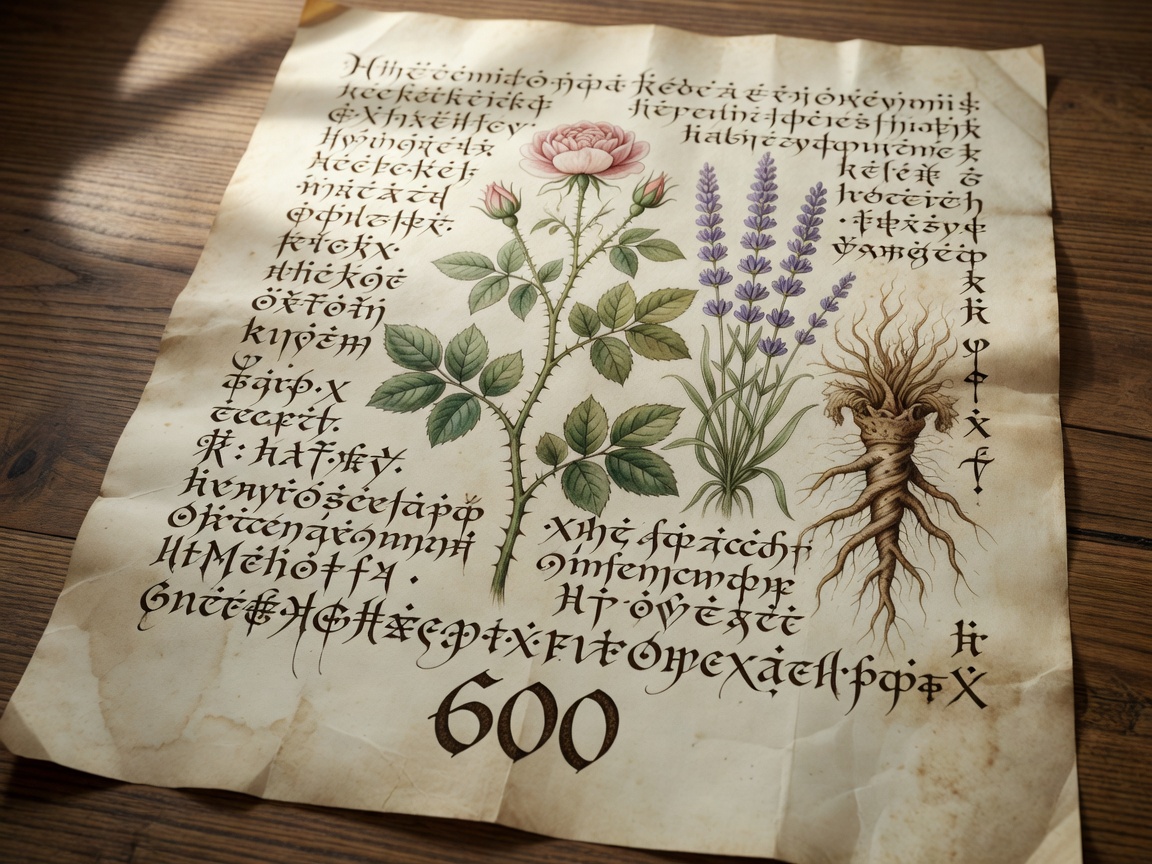
Cataloged as Beinecke MS 408 at Yale University, the Voynich Manuscript remains one of history’s most thoroughly scrutinized undeciphered codices. Containing roughly 240 surviving vellum folios covered in an unread script and fantastical botanical, astrological, and balneological illustrations, it has resisted both human cryptanalysts and modern neural network decipherment.
1. Material Codicology and Radiocarbon Calibration
In 2009, accelerated mass spectrometry (AMS) radiocarbon testing was conducted on samples from four different folios by the University of Arizona. The results dated the animal hide vellum with 95% statistical confidence between 1404 and 1438 CE (Early Quattrocento, Northern Italy / Alpine region).
Microscopic analysis of ink stroke sequencing and pigment degradation confirmed that the text and drawings were executed contemporaneous with the vellum preparation, ruling out the hypothesis of a 16th- or 20th-century forgery on salvaged antique parchment.
- Folios: ~240 surviving (estimated ~272 originally, grouped in 20 quires).
- Alphabet Size: 20–25 unique glyphs, plus rare ligature variants.
- Total Word Count: ~35,000 distinct word tokens ("Voynichese").
- Linguistic Split: Currier A and Currier B distinct statistical dialects.
2. Statistical Linguistic Properties
The text exhibits strange structural characteristics that both mimic and deviate sharply from natural European languages:
| Linguistic Metric | Voynichese Observed Data | Comparison to Natural Human Language |
|---|---|---|
| Zipf's Law | Conforms closely to a power-law word frequency curve | Matches natural language; extremely difficult to fake in an early 15th-century random hoax. |
| Word Entropy (h2) | Abnormally low second-order entropy (~3.5 bits/character) | Substantially lower than Latin (4.0), German (4.1), or English (4.2); exhibits rigid word grammar. |
| Word Repetition | High incidence of triple and quadruple identical words ("qokedy qokedy qokedy") | Extremely rare in natural spoken languages; suggestive of rhythmic chanting or table-based encipherment. |
| Word-Initial / Final Rules | Certain glyphs appear strictly at line starts or ends; letters rarely swap positions within words | Resembles Semitic root structures or a constructed substitution nomenclature. |
3. The Competing Decipherment Paradigms
Over a century of cryptographic analysis has yielded four main hypotheses:
A. Complex Polyalphabetic Cipher
Early researchers (including William Friedman, who led the US team breaking Purple during WWII) investigated the manuscript as an early mono- or polyalphabetic cipher with nulls. However, the lack of character randomness and the low entropy make standard substitution ciphers mathematically unlikely without a multi-layered transposition grille (such as a Cardan grille).
B. Natural Language in an Unknown Constructed Script
This view holds that the text represents an extinct or localized dialect (such as proto-Romance, Judeo-German, or an early Turkic dialect) transcribed phonetically into an invented alphabet. However, zero bilingual cribs or external glosses have ever been identified to anchor the phonetic values.
C. Constructed Artificial Language (A Priori System)
Similar to 17th-century philosophical languages (e.g., John Wilkins' analytical language), the words may represent hierarchical classification codes where individual letters describe category, genus, and species. This would explain the rigid prefixes and low entropy.
D. Medieval Therapeutic Hoax / Semiotic Construction
An alchemist or charlatan produced the book using a mechanical syllable generation table (such as a combinatorial wheel) to sell as an esoteric manuscript to wealthy collectors (such as Holy Roman Emperor Rudolf II).
4. Botanical and Pharmaceutical Enigmas
Of the 126 plant illustrations in the herbal section, only a handful (such as Viola tricolor and Nymphaea alba) bear convincing resemblances to real species. The vast majority appear to be chimeras: the root of one known plant grafted onto the foliage of another, joined with imaginary blossoms.
5. Current Academic Standing
With high-resolution digital scans now universally accessible through Yale University Library, modern computational linguistics continues to evaluate the codex. While statistical signatures confirm that the text is not random gibberish, no proposed translation to date has passed peer review or successfully deciphered a continuous passage. Beinecke MS 408 remains the ultimate unsolved puzzle of Western codicology.